

The world is run by those who turn up.
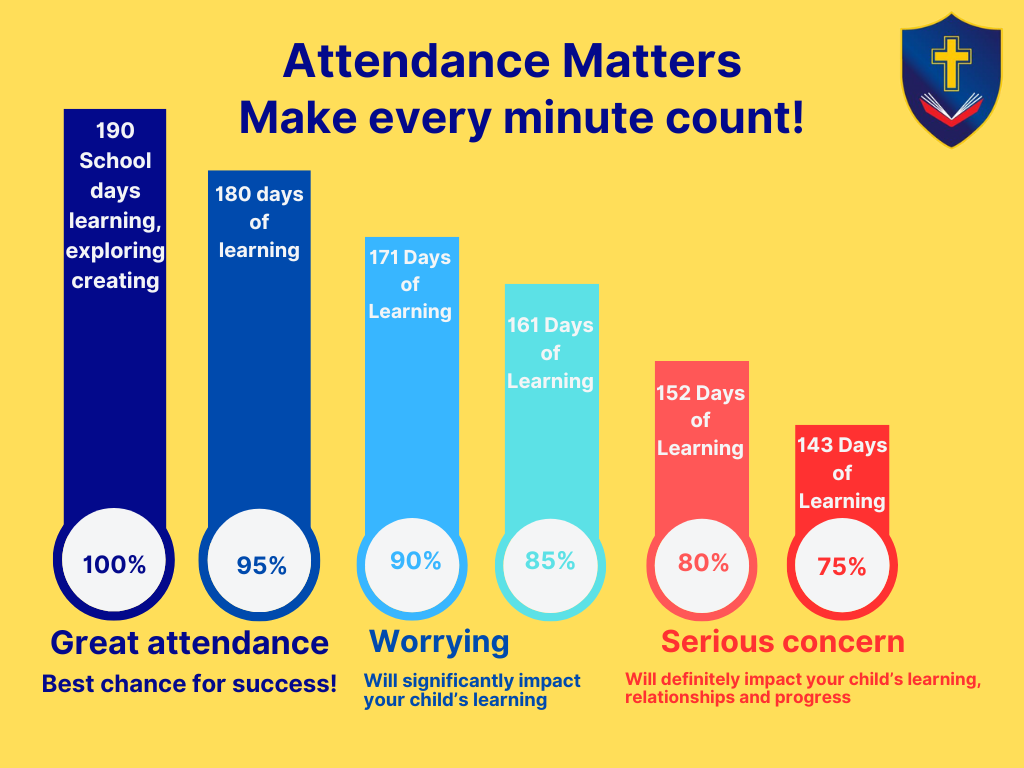
Attending school every day = 100% attendance
Attending 4½ days a week = 90% attendance
= 4 weeks missed per year
Attending 4 days a week = 80% attendance
= more than half a term missed per year
Attending 3½ days each week = 70% attendance
= more than a quarter of the school year missed.
An average attendance of 80% or less across a child’s school career adds up to missing a whole 2 years from school.
Being late for school reduces learning time. If your child is 5 minutes late every day they will miss three days of learning each year.
If your child is 15 minutes late every day they will miss 2 weeks of learning each year.
Attendance
Why is it important for children not to miss school?
All parents want the best for their children and for them to get on well in life.
Having a good education is important to ensure that they have the best opportunities in their adult life. They only get one chance at school, and your child’s future may be affected by not attending school or alternative provision regularly.
If children do not attend school regularly they may:
- Struggle to keep up with school work. In a busy school day it is difficult for schools to find the extra time to help a child catch up.
- Miss out on the social side of school life.
- Poor attendance can affect children’s ability to make and keep friendships; a vital part of growing up.
Setting good attendance patterns from an early age, from nursery through primary school will also help your child later on in their life.
Children who have a poor school attendance record may have less chance of securing a job when they are adults.
What about authorised absence?
There may be times when your child has to miss school because they are too ill. This is to be expected and you should contact the school office through the SchoolGateway, or email admin@hampdengurney.co.uk or call the school office 020 7723 7482. The NHS has provided useful information about illness for school children here: https://www.nhs.uk/live-well/is-my-child-too-ill-for-school/. Children may also have to attend a medical or dental appointment in school time. However, you should try to make routine appointments such as dental check-ups during the school holiday or after school hours. Please provide us with evidence of any appointments made during school time. This could be a screenshot of an appointment confirmation text message from your dentist or GP, or a letter from the NHS.
Any absence must be requested as far in advance as possible. Absences can only be authorised by the school.
Punctuality

Being on time is also vital. Arriving late at school can be very disruptive for your child, their teacher and the other children in the class.
Some parents may be finding it difficult to ensure that their child attends school regularly. If this is the case please speak to Mrs Chua as soon as possible so that the situation can be addressed.
We urge all parents to ensure your child is present inside school by 8.55am.
The school doors open at 8.45am and children assemble in the lower ground floor. Anyone arriving later than 9.00am will be recorded into a ‘late book’. Anyone arriving late due to a medical or other appointment must be signed in at the school reception.
It is MOST important that the children are able to begin their day calmly and on time. Registration takes place immediately when pupils have entered the classroom. This is often the time when teachers give them notices and information. We thank all those parents whose children are on time. If your child is late, their lateness may be marked as unauthorised for that session. The school tracks any late arrivals to check for patterns of poor punctuality; those families causing concern will be contacted to arrange a formal meeting.
What can you do to help?
- If you suspect that your child may be missing school or is unhappy at school you should contact the school as soon as possible so that you can work with them to resolve any difficulties.
- Be on alert for any particular reasons for non-attendance, such as bullying or problems with school work and discuss these with the school.
- If your child is ill or absent for any other reasons, contact the school on the first day of absence.
- Follow the schools’ procedures for notifying absence, and always let the school know of any days that your child is unable to attend.
- Make sure your child arrives at school on time.
- Take an interest in your child’s education. Ask them about their day and praise and encourage their achievements at school.
What might the impact of poor attendance be on your child?
In primary schools less than 65% of children achieve good results in English and Maths with an average of 15 days absence a year compared to almost 90% where the average is less than 8 days. Parents can be very surprised at how quickly their children can accumulate 15 days absence within a year.
Research has also shown that children who are not in school can become vulnerable. For example, children who play truant are more likely to be drawn into crime than those who do not.
What does the law say?
By law, all children of compulsory school age (between 5 and 16) must receive a suitable, full time education. As a parent, you are responsible for making sure this happens, either by registering your child at a school or by making other arrangements which provide a suitable full time education.
Once your child is registered at a school you are responsible for making sure he or she attends regularly. If your child fails to attend regularly – even if they miss school without you knowing – the Local Authority (LA) may take legal action against you.
The LA is responsible for making sure that parents fulfil their responsibilities. Parents are responsible for making sure that their registered children regularly attend school or any alternative provision arranged them.
If you think you might need to take your child out of school, discuss the reasons with the school as soon as possible.
Reasons such as family bereavement or taking part in an agreed religious observance would be acceptable for short absences.
Unacceptable reasons for missing school include family holidays, birthdays and shopping.